The Designated Person and the Power of Witness
Sasha Perry’s D’var Torah for Yom Kippur 5787
The first time I went “undercover” I was 15. I had just gone to a hardcore show at a tiny venue in Las Vegas, some awful pirate-themed band dressed in costumes. My best friend and I had gone to recruit people to join us in protest of the national finals rodeo while they were in town at the university. We gathered a few loyal folks, and took a bus over to stand on the sidewalk as cars drove into the parking lot. Bunch of teenagers all in black, at least 20 lip piercings between the dozen of us, and our very clever signs that said things “buck animal cruelty,” and “real men last longer than 8 seconds.” At some point I went inside with my video camera, and began recording. Horses and bulls writhing and spasming in small cages, attempting to kick and claw their way out. I later used that footage on top of a pro-rodeo fan from my high school explaining how well the animals are treated and how much the animals enjoy doing it. I thought it was brilliant journalism.
It would not be the last time I used filmmaking to witness, and luckily got much better at it. From factory farms, hunt sabotage, animal testing, to black market trafficking of cocaine, the fight for trans healthcare in the US, the struggle for water and safety in Hebron and the West Bank. I made my entire life about witnessing with a camera, specifically the canon XL1 that is now tattooed on my shin with a banner that reads ‘there is a war this is a weapon’ (a nod to the band Earth Crisis who created my politics, and unfortunately my personality). The desire to document and share with the world all the injustices that were behind closed doors became my only focus for the better part of 20 years. I was convinced that people just needed to see what was happening and they would also want to make it better. How could you not. It was and still is my avodah, my work and my service.
The part of the Torah we just chanted describes the Temple ritual that occurs on Yom Kippur. During Musaf prayers today we will read the Avodah service, where we recite in detail this bizarre sympathetic magic goat ritual. While the Temple no longer stands, our sages have taught that reciting this service outloud is the same as performing the ritual, as our words are equivalent to the actions. This Avodah service is where we encounter the ish iti..
“Then Aaron shall lay both his hands upon the head of a live goat and confess over it all the iniquities and transgressions of the Israelites, whatever their sins, putting them on the head of the goat. וְשִׁלַּח בְּיַד־אִישׁ עִתִּי הַמִּדְבָּרָה Then the goat shall be sent off to the wilderness by the hand of an ish iti, a designated person. On Yom Kippur the high priest would select two identical (as much as possible) goats, draw lots to decide their fate, assigning one “For Gd” and the other “for azazel” The Goat for Gd would be offered as a sin offering on the Temple altar. Azazel’s goat, however, would have the priest’s hands placed on their head as he confesses over it all the sins and transgressions of the community. Azazel, עֲזָא meaning strength, something strong, hard, stubborn. Some of our Rabbinic sages say that it was a cut mountain with jagged rocks, a place of cliffs. Some say it wasn’t even a destination but fallen angels and partially a demon (honestly this metaphor work with that view too), and one commentator, Ibn Ezra, refuses to explain what azazel even is and says there's a great secret here.
Normally, a sin would be confessed over the animal that was sacrificed in the Temple. But on Yom Kippur, the High Priest confessed the sins of the people over the animal that was not sacrificed, the scapegoat that was sent away, “carrying on it all the people’s iniquities”
These two goats represented the two kinds of sins that needed atonement. Only accidental sins can be remedied by a sacrifice brought in the temple. You forgot it was Shabbat and you lit a fire, someone served you food that mixed milk and meat. Intentional sins, however, these can only be atoned for through this ritual of azazel. Of putting those sins onto this goat, taking them to the wilderness, and throwing them off a cliff. You can't take these intentional sins and put them on the altar inside the Holy Temple. Gd doesn’t want them.
What is the sin that is too big for Gd? What are the sins that are too big for Gd
Anas Jamal al-Sharif was born in Jahbaleeuh refugee camp. His family had been displaced from their home in 1948. At the age of 12 during a different Gaza war, he was interviewed by Al Jazeera and told them he wanted to be a journalist when he grew up. By the start of the attacks on Gaza in 2023 Anas was working for multiple news outlets as a photographer, and quickly became a voice reporting on the annihilation of Gaza. Despite many threats against his own life, Anas refused to leave Northern Gaza; continuing to document and witness, and share with the world. In his own words, “When I convey the suffering of one of the people of Gaza, I feel that I have made even a small contribution… Therefore, before I am a journalist, I am the owner of a cause.” If people just see what’s happening, it can change.
An internet search of his name brings up a half page of results describing his work, followed by multiple pages trying to connect him with Hamas, or the media outlet Al Jazeera with Hamas, or someone Anas maybe might have known as Hamas… Anas Al-Sharif won a Pulitzer Prize for Breaking News Photography for his coverage of the ongoing attacks on Gaza… He was 30 years old when he and 4 other journalists were targeted and killed by an Israeli air strike outside Al-Shifra hospital in a marked Press tent.
According to the Committee to Protect Journalists more media workers and journalists were killed in 2025 than in any other year over the last 30 years. With targeted drone attacks jumping from 2 in 2023 to over 39. With increased journalist deaths in areas with armed conflict like Ukraine and Sudan, the majority of deaths were Palestinians killed by the Israeli government. Since the siege on Gaza began, over 250 journalists have been killed.
Last week an Israeli documentary called Naza premiered. Naza is the word used by Israeli military for collateral damage, the number of “ permittable civilian deaths” when carrying out targeted attacks. Almost immediately the Israeli government accused the filmmakers of treason, threatened to revoke their citizenship, and launched online attacks against them and the film. There is still power in the act of witnessing, particularly the sins that are too big for Gd’s Temple.
Along the journey to Azazel, the ish iti would pass by 10 sukkot. At these tents were members of the community that would join the walk with them to bear witness, ensuring they were not doing this task alone. They would offer bread and water, a rest on the journey that was no doubt physically and emotionally taxing. These guards could only walk so far with the designated person, but the task was to keep witnessing… watch as the goat with the sins of the community and the ish-iti went off into the distance. After the last sukkah, a distance from the cliff’s edge, the witnesses would end their journey, and the ish iti would go it alone. I’ve been thinking about those sukkot, those tents along the way, with the community members waiting for the ish iti and the sins of the people to approach. Seeing them first off in the distance, choosing to witness or not, deciding if they will join them in the journey, or not. Presumably, they had a choice.
Many times in our lives we will be faced with this choice. To walk alone guided by our sense of purpose, to be outside of the larger community, finding ourselves in the wilderness. Or to stay put. Where its comfortable, or at least where we are familiar with our toxic patterns. Often those first steps towards liberation require a holy risk.
Each day that has passed since the genocide in Gaza began, people have witnessed and had to reckon with the horrors occuring. And a decision had to be made. To stay in the tent or to go out.
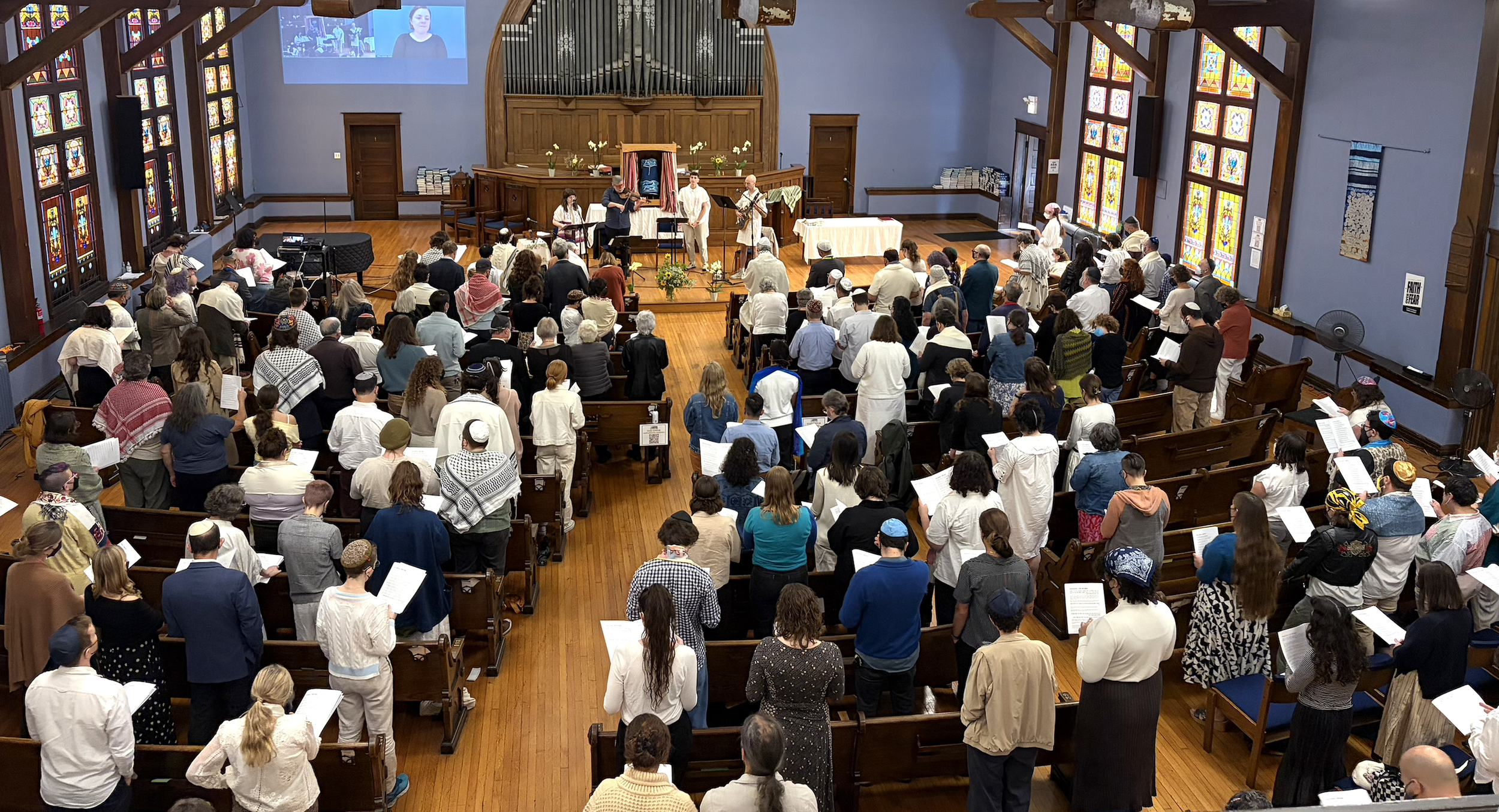
Some of you were first a witness, you saw what was happening in the world around you, the sins of your community being brought to your tent, and you chose to join the walk to azazel. And some of you have been walking the path to azazel for a long time, dragging the sins of the nakba, of displacement, of death, from community to community holding them up for all to witness, begging them to join. If you see this, you will also want to change it. Walk this path, bring the sins of jewish supremacy, ethnonationalism, and zionism to the cliff’s edge. Come with me, I can’t do this alone. In some ways Tzedek Chicago has been the Ish iti, the person of designated time. And as the first antizionist synagogue we've walked from tent to tent, making a path for others to join both the movement, and the identity. Come with us, we can’t do this alone.
I’ve been on a bit of a 1:1 campaign to meet you all since I arrived. It's been a true joy, if sometimes a slightly overcaffeinated joy. So many of you have expressed similar sentiments around the role of Tzedek Chicago and its future. You’ve told me that:
I’m so glad we identify as an antizionist synagogue, and….
We're so proud of Tzedek Chicago for being the first anti-zionist synagogue, and …
I understand antizionism is important, and….
We know what we’re against... What are we for?
Anishanabee author Patty Krewc spoke to the oppositional identity that so many here are holding saying, “Everything exists in opposition to colonialism, right? Indigeneity to a certain degree. We weren't Indigenous before the colonists got here. I was Ojibway… we didn't have this collective identity that placed us in opposition to another collective identity. We were ourselves. So whatever identity, it's existing in counterpoint to a binary that just doesn't work. It doesn't work for anybody. I just keep thinking about how we keep identifying ourselves in opposition to something.”
What has been expressed by folks in this room is a desire to de-center israel, and re-identify in the collective what this community is for. And I want to be clear this goes beyond the single word phrases of doikayt, the yiddish word for hereness, or diaspora or neodiaspora, or even galut, the word for exile. Whether these are just titles or an identity, they still hold the energy of identifying ourselves in opposition to destructive power structures.
In Patty’s view, what diasporic communities need in this process of reclamation and identity formation is history, she asks, “What are the teachings we need to ground ourselves in, the work that I need to do… what do you need to pick up and connect with from your own histories from your own past, what has been taken from you that you can pick back up again to help us move forward in a way that isn't these maleformed power structures.”
What is the question Yom Kippur is answering?
We started at Rosh Hashanah with endings,beginnings and the failure of creation - and we were asked by Champagne Song ‘what will we do in the time of great failures?’ Last night was overwhelming loss and risk..What are we willing to risk in these protracted emergencies, what is our expansion of risk needed right now? In the three act structure, today is the 3rd act, today is the what's next.
Rabbi Brant was just quoted in an article about all these new antizionist synagogues created post October 7th. And he said we're not content just to be an alternative, we want to be the hegemony.” So we’re going to take a few minutes now to answer that question together. In front of you in the pews are notecards and pencils if it's in your practice to write on yom kippur. We're going to turn to some folks next to us, particularly if you've never met them. And we are going to imagine we are at the 10th sukkah on the journey to Azazel. We are on the verge of throwing the sins of the community off a cliff…What's next?
‘But Sasha, there’s still a genocide happening, how can you ask whats next’? I am not naive in thinking that we have ushered the goat of zionism off the clif of azazel. But if we wait until the current hegemony re-defines Judaism and name who we are, it will be too late.
So what are the teachings, what has been taken from us that we can pick back up to move us forward away from the sins of colonialism and ethnonationalism. How do we identify if not in opposition.
One of our sages translates the ish iti, this goat shepherd, as ‘a time-bound man.’ Meaning the person had been chosen because he was not going to live beyond the next year. The last act of the ish-iti’s life, is to protect their community from their own sins.
I want to hold the space that we have crossed over many of the sukkot, we have brought witnesses and guards with us, in debt to the Palestinian journalists who have risked their lives to broadcast these images and force the world to see what they want to ignore. It is because of this witnessing that we are closer to azazel on this Yom Kippur than we were from the last one.
When the ish iti finishes this task, and the sins of the community have been left in the wilderness, they must walk back to the temple to announce that the job is done. A long walk back, not in celebration, but mourning, for all that has been done. Now is the time to think of what we will say, what we will stand for when we get back to the community, to tell them zionism is gone.
We must continue on to Azazel this Yom Kippur and next until the community has extracted from itself the sins of zionism and the ish iti can go back to the Temple to declare, it is done.
May we each find the strength and courage to be the ish iti, to welcome the witnesses from the tents who are joining on the path, may we own our responsibility for the sins of our community and move with haste towards the work that brings justice.